
Supporting Water and Wastewater Infrastructure with Expansion Joints and Metal Hose
Reliable water and wastewater infrastructure is essential to public health, environmental protection, and the communities and industries that depend on it. Treatment facilities, pumping stations, filtration systems, and chemical-handling processes must operate continuously under demanding conditions.
Within these systems, piping is exposed to vibration, pressure fluctuations, temperature changes, corrosive media, and mechanical movement. Properly selected expansion joints help manage these conditions, giving the audience confidence in their system protection and longevity.
Vibrant Power supplies metallic, rubber, fabric, and PTFE expansion-joint solutions, along with flexible metal hose assemblies, for water and wastewater applications. Our team’s expertise ensures customers feel supported in choosing solutions that promote dependable performance and long-term reliability.
The Role of Expansion Joints in Water and Wastewater Systems
Piping systems are rarely completely static. Pumps create vibration, equipment can shift during operation, and piping can expand or contract as temperatures change. Installation tolerances and structural settlement can also introduce misalignment or mechanical stress.
Expansion joints are designed to accommodate specific types of movement while maintaining the integrity of the piping system. Depending on their design and location, they can help:
- Accommodate axial, lateral, and angular movement
- Isolate vibration generated by pumps and other equipment
- Reduce stress transferred through connected piping
- Compensate for thermal expansion and contraction
- Protect pumps, valves, flanges, and other components
- Support reliable flow through the system
Without appropriate movement control, stress can be transferred to piping connections and equipment. Over time, this may contribute to leaks, premature component wear, increased maintenance requirements, and unplanned service interruptions.
Expansion-Joint Applications Across Treatment Facilities
Water and wastewater treatment involves numerous interconnected processes. Each can present different pressure, temperature, movement, chemical, and corrosion requirements.
Expansion joints and flexible metal hose assemblies may be found in applications such as:
- Water and wastewater treatment plants
- Pumping and lift stations
- Intake and discharge piping
- Aeration and blower systems
- Filtration and backwash systems
- Sludge-processing systems
- Chemical dosing and treatment lines
- Odor-control systems
- Large-diameter piping
- Industrial water-treatment systems
- Flexible connections to pumps, blowers, equipment skids, and instrumentation
- Chemical-transfer and dosing connections requiring corrosion-resistant hose materials
Because operating conditions vary throughout a facility, one expansion-joint design or material will not be suitable for every application, highlighting our commitment to providing tailored solutions for each unique need.
Rubber Expansion Joints for Water-Handling Applications
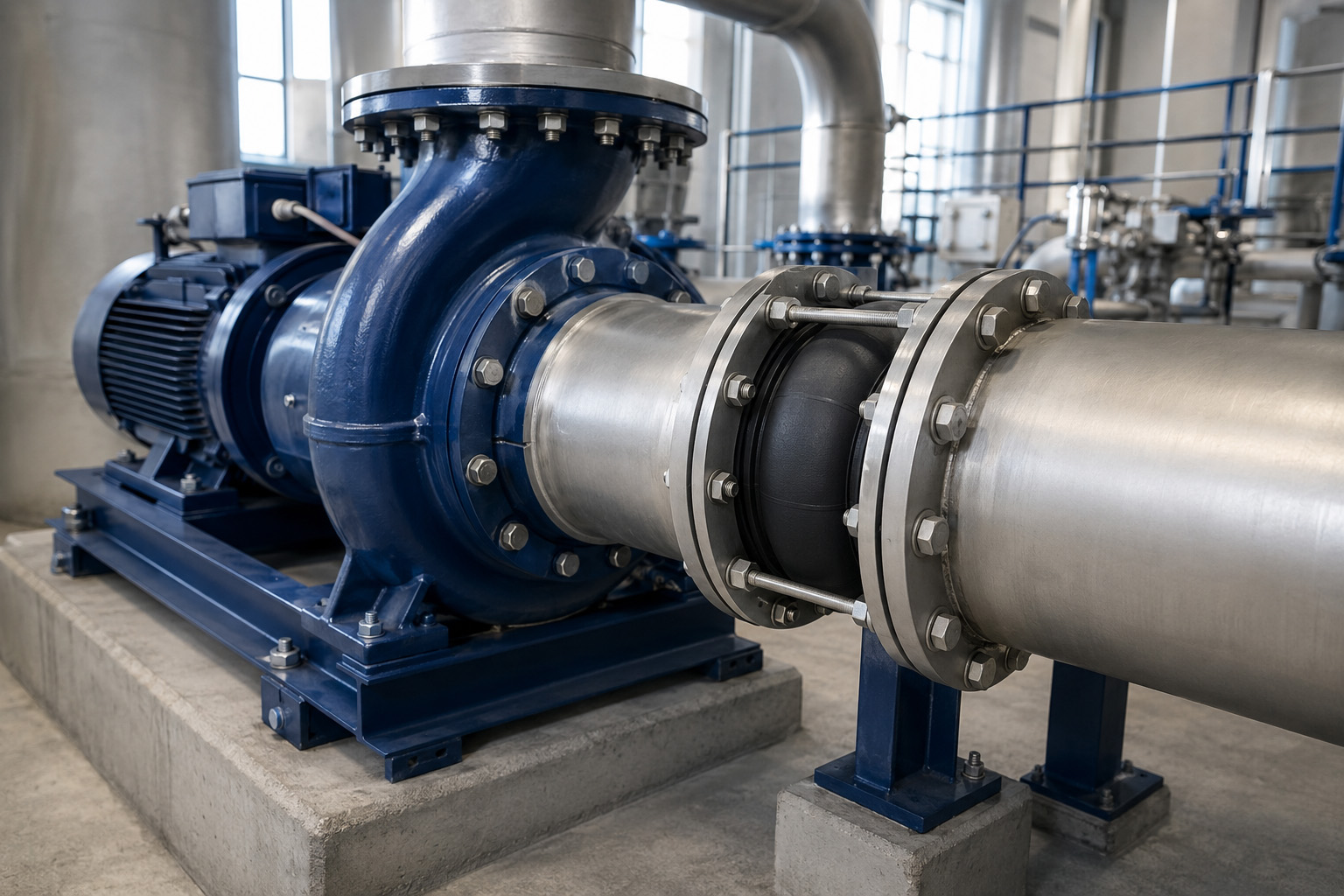
Rubber expansion joints are frequently used around pumps and in water-handling piping systems. Their flexible construction can accommodate movement while helping isolate vibration and reduce noise transmission.
Depending on the selected elastomer and reinforcement, rubber expansion joints can be used in applications involving water, wastewater, sludge, and other process media. They are available in different configurations to address system dimensions, operating pressures, movement requirements, and installation conditions.
The elastomer’s compatibility with the process media is an important consideration. Temperature, pressure, chemical exposure, and expected service conditions must all be reviewed before selecting a rubber expansion joint.
PTFE Expansion Joints for Chemical-Treatment Systems
Water and wastewater treatment facilities use various chemicals for disinfection, pH control, coagulation, odor management, and other treatment processes. These chemicals can create challenging conditions for piping components.
PTFE expansion joints provide strong resistance to a broad range of corrosive chemicals. This makes them an option for certain chemical-transfer and dosing applications where conventional materials may not provide suitable compatibility.
The specific chemical concentration, temperature, pressure, movement, and system configuration should be evaluated when determining whether a PTFE solution is appropriate.
Metallic Expansion Joints for Demanding Conditions
Metallic expansion joints can accommodate thermal movement and vibration in piping systems operating under demanding pressure and temperature conditions. They can be engineered in various configurations based on the required movement, operating environment, and available installation space.
Material selection is critical, particularly when an expansion joint will be exposed to moisture, chemicals, chlorides, or corrosive process media. The choice of stainless steel or another corrosion-resistant alloy should reflect the actual operating environment.
Metallic expansion joints must also be integrated into properly designed piping systems with suitable anchors, guides, and supports.
Fabric Expansion Joints for Air and Gas Systems
Fabric expansion joints are commonly used in low-pressure air and gas-handling applications. Within water and wastewater facilities, they may be used in aeration, ventilation, blower, or odor-control systems.
Their flexible construction can accommodate movement in multiple directions while helping isolate equipment vibration. The fabric and reinforcement materials must be selected according to temperature, chemical exposure, airflow, pressure, and environmental conditions.
Metal Hose Applications in Water and Wastewater Facilities
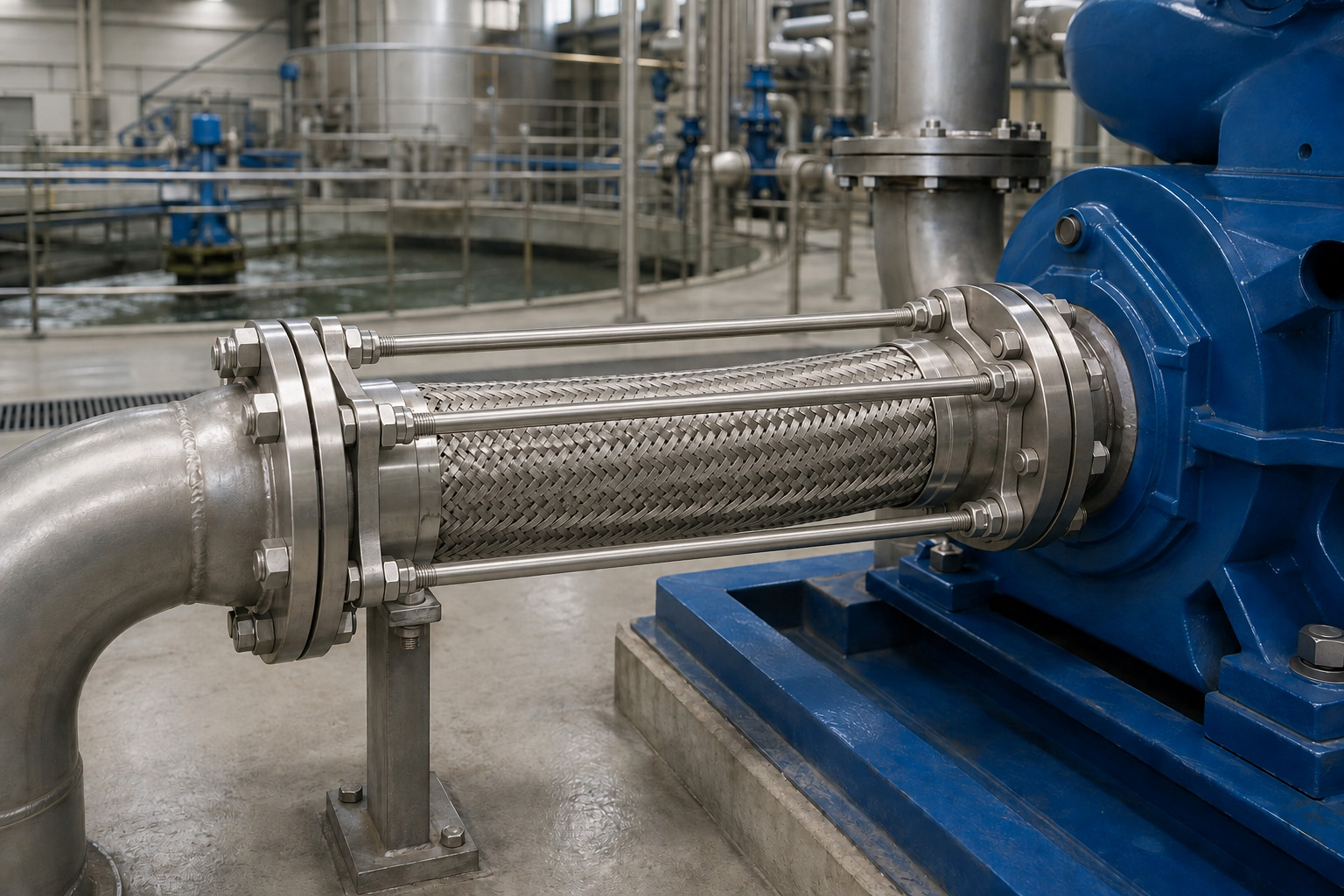
Flexible metal hose assemblies are an important part of Vibrant Power’s water and wastewater capabilities. They provide a durable, flexible connection where rigid piping would transfer vibration, where minor movement or installation tolerances must be accommodated, or where equipment connections require more routing flexibility.
Where metal hose can be used
- Pump suction and discharge connections where vibration must be isolated from adjacent piping
- Blower, compressor, and aeration-system connections exposed to equipment vibration
- Chemical-transfer and dosing lines requiring compatible, corrosion-resistant materials
- Connections to equipment skids, valves, meters, and instrumentation
- Tight or complex piping layouts where a rigid connection is impractical
- Maintenance and replacement projects where installation tolerances must be accommodated
How a braided metal hose assembly works
The flexible element is a corrugated metal hose, commonly manufactured from stainless steel selected for the service environment. The corrugations allow the hose to flex, while one or more external braid layers provide pressure restraint and help protect the corrugated hose. Welded or mechanically attached end fittings—such as flanges, threaded connections, or weld ends—allow the assembly to be integrated into the piping system.
For corrosive water, wastewater, or treatment chemicals, the hose, braid, fittings, and weld materials must all be compatible with the media and surrounding environment. Material selection should consider chlorides, chemical concentration, washdown exposure, and the possibility of external corrosion.
What metal hose helps accomplish
- Reduce vibration transmitted from pumps, blowers, and rotating equipment
- Accommodate limited axial, lateral, or angular movement when the assembly is designed for that motion
- Provide flexibility for equipment connections and difficult routing conditions
- Handle demanding pressure and temperature conditions when properly engineered
- Support reliable containment of water, wastewater, air, and compatible treatment chemicals
Selection and installation considerations
A metal hose assembly must be selected as a complete engineered connection—not simply by pipe diameter. Important details include the process media, operating and design pressure, temperature, required movement, vibration frequency, assembly length, minimum bend radius, end connections, installation orientation, and expected number of operating cycles.
Correct installation is equally important. The hose should not be twisted, sharply bent, compressed, stretched, or installed below its minimum bend radius. The assembly must be properly supported and oriented so the movement occurs in the direction for which it was designed. Where significant thermal growth or large movement is present, the application should be reviewed to determine whether a metal expansion joint is more appropriate.

Why Application Details Matter
Selecting an expansion joint involves more than matching the pipe diameter. A reliable recommendation requires a clear understanding of the complete application.
Important details include:
- Pipe size and connection type
- Operating and design pressure
- Minimum and maximum temperature
- Process media and chemical concentration
- Required axial, lateral, and angular movement
- Frequency and source of vibration
- Installation length and available space
- Piping layout and orientation
- Environmental and corrosion conditions
- Existing anchors, guides, and supports
- Expected operating cycles
Reviewing these factors helps determine the appropriate expansion-joint type, construction, material, and configuration. It also reduces the risk of selecting a product that may not be compatible with the system’s actual operating conditions.
Supporting Reliable Water and Wastewater Operations
Every water and wastewater facility presents a different combination of movement, vibration, pressure, temperature, and media. Expansion joints must be selected with these conditions in mind.
With access to metallic, rubber, fabric, and PTFE expansion-joint solutions and flexible metal hose assemblies, Vibrant Power supports treatment facilities, engineering teams, contractors, equipment manufacturers, and maintenance professionals across a wide range of applications.
Whether the requirement involves a new installation, equipment replacement, piping modification, or maintenance project, our team can help review the application and identify an appropriate expansion-joint or flexible metal hose solution.
